
 darin
darin Understand your tax residency status first—Canada Revenue Agency considers you a tax resident if you have significant residential ties here, even while maintaining UK connections. This determination affects whether you pay tax on worldwide income or only Canadian-source earnings, and impacts your access to the Canada-UK tax treaty benefits that prevent double taxation. Secure professional UK tax advice for expats early to establish proper reporting in both countries before you begin operations.
Register your business structure strategically. Sole proprietorships offer simplicity but expose you to unlimited liability, while incorporating provides tax deferral opportunities through the small business deduction—reducing federal tax to 9% on the first $500,000 of active business income. Your choice impacts how you’ll report income, claim expenses, and manage obligations across both tax systems.
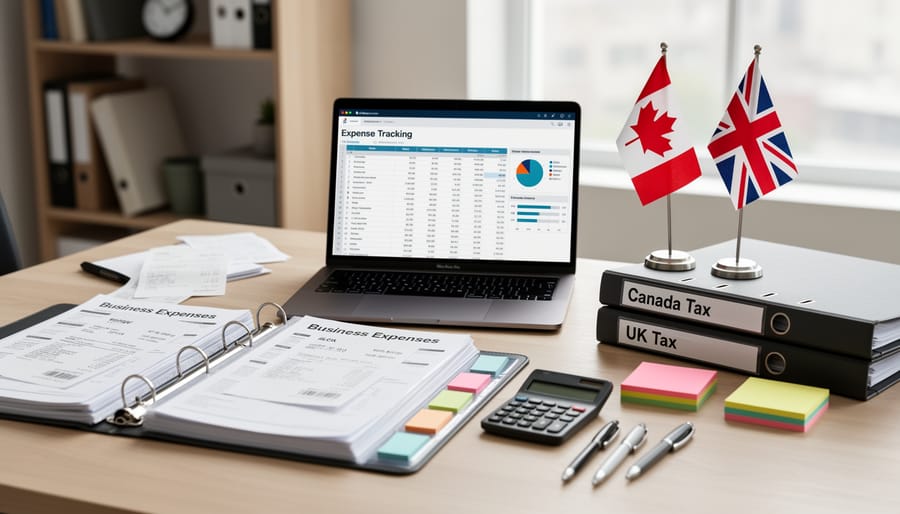
Track every business expense meticulously from day one. Home office costs, vehicle usage, professional development, and equipment purchases all reduce your taxable income, but Canada Revenue Agency requires detailed documentation. Many UK expats overlook allowable deductions or fail to maintain adequate records, triggering reassessments and penalties years later.
File HST/GST returns correctly and on time. If your revenue exceeds $30,000 annually, you must register, collect sales tax, and remit it quarterly or annually. Missing deadlines creates compounding interest charges and potential audit triggers.
The tax landscape for UK expats running Canadian small businesses involves navigating two complex systems simultaneously. Getting it wrong costs significantly more than getting professional guidance from the start.

Your Tax Status as a UK Expat in Canada
When Canada Considers You a Tax Resident
Canada determines your tax residency through a residential ties test, which looks at your connections to the country rather than just your citizenship. As a UK expat, you’re generally considered a Canadian tax resident if you maintain significant residential ties here.
The Canada Revenue Agency examines several key factors. Primary ties include having a home in Canada, a spouse or common-law partner in Canada, and dependants living in the country. Secondary ties can include Canadian bank accounts, a driver’s license, provincial health coverage, and memberships in Canadian organizations.
Length of stay matters too. If you spend 183 days or more in Canada during a tax year, you’re typically deemed a resident for tax purposes, even without other ties. This is particularly important for UK expats testing the waters with a new business venture.
Your situation might be straightforward if you’ve relocated your entire life to Canada. However, if you maintain connections in both countries, you could face dual residency. The Canada-UK tax treaty provides tie-breaker rules to determine where you’re primarily resident, helping you avoid double taxation on the same income. Understanding your residency status is the foundation for meeting your Canadian tax obligations correctly.
What This Means for Your UK Tax Obligations
As a UK expat running a small business in Canada, understanding your UK tax obligations is essential to avoid unexpected costs. Your tax residency status determines where you owe taxes. If you’ve established Canadian tax residency, you’ll typically file your primary tax return in Canada, but you may still need to report certain income to HMRC depending on your UK ties.
The good news is that the Canada-UK Tax Treaty helps prevent double taxation on the same income. This agreement allows you to claim foreign tax credits, meaning taxes paid in Canada can often offset your UK tax liability. However, you’ll still need to declare your worldwide income to HMRC if you remain a UK tax resident or have UK-sourced income.
Common considerations include whether you’ve maintained a UK property, the frequency of your UK visits, and your family’s location. These factors influence your residency status. While managing dual obligations may seem complex, proper planning ensures compliance in both countries. Working with professionals familiar with cross-border taxation provides a cost-effective solution, helping you maximize deductions while avoiding penalties and ensuring you benefit fully from treaty provisions.
Canadian Small Business Tax Basics You Need to Know
Sole Proprietorship vs Corporation: Which Makes Sense?
When starting a business in Canada, most UK expats face a straightforward choice: operate as a sole proprietor or incorporate. Each structure has distinct tax implications that affect your bottom line.
As a sole proprietor, you’re taxed personally on all business income. You report earnings on your personal tax return, and profits are taxed at your marginal rate, which can reach over 50% in some provinces when combined with federal rates. The main advantage is simplicity. There are minimal setup costs, straightforward bookkeeping requirements, and no separate corporate tax filings. This makes it an excellent starting point for most UK expats testing a business idea or earning modest income.
Incorporating creates a separate legal entity. Your corporation pays tax at the small business rate of approximately 11-12% on the first $500,000 of active business income, significantly lower than personal rates. This allows you to retain earnings within the company and defer personal tax until you withdraw funds as salary or dividends. However, incorporation involves setup costs, ongoing legal requirements, and more complex accounting needs.
For UK expats just starting out, sole proprietorship typically makes the most sense. It keeps things manageable while you establish your business and understand Canadian tax obligations. Once your business consistently generates more income than you need personally, incorporation becomes attractive. You can leave profits in the corporation at the lower tax rate and manage your personal income strategically.
The transition point varies, but many businesses consider incorporating when annual profits exceed $75,000-$100,000. Professional guidance helps determine the right timing for your specific situation.
The Small Business Deduction Advantage
Canada offers a significant tax advantage for small business owners through the Small Business Deduction (SBD). This federal program reduces the corporate tax rate on the first $500,000 of active business income earned by Canadian-controlled private corporations. Instead of paying the general corporate tax rate, eligible businesses benefit from a combined federal-provincial rate that typically ranges between 11% and 15%, depending on your province.
As a UK expat operating a small business in Canada, you can access this reduced rate if your corporation qualifies as a Canadian-controlled private corporation. This means your business must be primarily owned and controlled by Canadian residents. The savings can be substantial, allowing you to retain more profits for reinvestment or personal income.
To maximize this benefit, it’s important to structure your business properly from the start and incorporate effective tax planning strategies. The SBD applies only to active business income, not passive investment income, so understanding which revenue streams qualify is essential. Working with a professional who understands both Canadian tax law and your UK obligations ensures you take full advantage of this cost-effective opportunity while remaining compliant in both countries.
HST/GST Registration: When and Why
As a UK expat running a small business in Canada, understanding your HST/GST obligations is essential for staying compliant. The Harmonized Sales Tax (HST) or Goods and Services Tax (GST) applies to most goods and services sold in Canada.
You must register for HST/GST when your business earns more than $30,000 in revenue over four consecutive calendar quarters. This threshold applies to your worldwide taxable supplies. Once you cross this amount, you have 29 days to register with the Canada Revenue Agency.
Registration brings both obligations and benefits. You’ll need to collect HST/GST from your customers and remit it to the CRA regularly. However, you can also claim Input Tax Credits to recover the HST/GST you pay on business expenses, which often reduces your overall tax burden.
Some UK expats choose to register voluntarily before reaching the threshold, particularly if they have significant business expenses. This allows you to start claiming credits immediately, improving your cash flow. Small suppliers under the threshold aren’t required to register but may do so if it makes financial sense for their situation.
Understanding these requirements helps you plan effectively and avoid penalties for late registration.

Avoiding Double Taxation: The Canada-UK Tax Treaty
How Foreign Tax Credits Work
Foreign tax credits help prevent you from paying tax twice on the same income. When you operate a Canadian small business as a UK expat, you may owe taxes in both countries on your business earnings. The good news is that Canada and the UK have a tax treaty specifically designed to address this situation.
Here’s how it works in practice: if you pay income tax in Canada on your business profits, you can typically claim a credit for those taxes when filing your UK tax return. This credit reduces your UK tax liability on the same income. The reverse also applies. You can claim Canadian tax credits for UK taxes paid, though most UK expats with Canadian businesses will primarily use the UK foreign tax credit system.
The amount you can claim equals the lower of either the foreign tax paid or the amount of domestic tax you would owe on that income. For example, if you paid $5,000 in Canadian tax but would only owe £3,000 in UK tax on the same income, your credit is limited to £3,000.
To claim these credits, you’ll need documentation proving the taxes you paid in the other country. Keep your tax returns, payment receipts, and any tax certificates from both revenue agencies organized and accessible.
While the concept is straightforward, calculating the exact credit amount can become complex, especially with different tax rates, deductions, and timing between the two countries. Professional accounting support ensures you maximize these credits without making costly errors.
Which Income Gets Taxed Where
Understanding where different types of income get taxed helps you avoid paying twice on the same earnings and ensures you meet your obligations in both countries.
As a UK expat running a Canadian small business, your business income is generally taxed where you’re considered a tax resident. If you’re living and working in Canada, your business profits from Canadian operations are taxed in Canada. The UK-Canada tax treaty prevents double taxation, allowing you to claim foreign tax credits on your UK return for taxes already paid in Canada.
Investment income follows similar principles but with important differences. Interest and dividends earned in Canada are typically taxed in Canada first, with the treaty limiting how much the UK can tax the same income. Capital gains from selling business assets or investments are usually taxed where you’re resident, though specific rules apply to property sales.
Pension income can be more complex. Canadian pension payments to UK residents may be taxed in both countries, but treaty provisions often reduce the rates. UK pension income received while living in Canada is generally taxed in Canada, though some UK government pensions may only be taxable in the UK.
The key is determining your residency status accurately. If you maintain significant ties to both countries, you may need professional guidance to establish where you’re considered resident for tax purposes. This determination affects which country has primary taxation rights and how you claim treaty benefits to prevent paying tax twice on the same income. Proper planning ensures cost-effective compliance in both jurisdictions.
Tax Deductions That Benefit UK Expat Business Owners
Home Office Expenses You Can Claim
If you run your small business from home, you can claim a portion of your household expenses as business deductions. The Canada Revenue Agency allows two calculation methods: the simplified method or the detailed method.
The simplified method lets you claim $2 per day for each day you worked from home, up to a maximum of $400 annually. This option requires no receipts and works well if you have minimal expenses.
The detailed method calculates the business-use percentage of your home. Measure your workspace area and divide it by your total home square footage. Apply this percentage to eligible expenses like rent, mortgage interest, utilities, property taxes, home insurance, and internet service. Keep detailed records and receipts for all claims.
Important considerations for home office deductions: your workspace must be your principal place of business, or you must use it exclusively to earn business income and meet clients regularly. You cannot claim mortgage principal payments or capital improvements through this deduction.
If you’re renting, your entire monthly rent is eligible for the percentage calculation. Homeowners can claim mortgage interest but not the principal portion. Working with an accountant ensures you maximize your claim while staying compliant with CRA requirements.
Vehicle and Travel Deductions
As a UK expat running a small business in Canada, you can claim vehicle expenses when your car is used for business purposes. The Canada Revenue Agency allows you to deduct a reasonable portion of your vehicle costs based on the percentage of business versus personal use. Keep detailed records of your mileage, fuel receipts, insurance, maintenance, and lease or loan payments. A simple logbook tracking your business trips will support your claims.
If you travel between Canada and the UK for legitimate business reasons, these expenses may also be deductible. This includes airfare, accommodation, and meals during your trip. However, the travel must be primarily for business activities such as meeting clients, attending trade shows, or managing business operations. Personal vacation days mixed into business trips cannot be claimed.
The key to maximizing these deductions is maintaining clear documentation. Save all receipts and keep notes explaining the business purpose of each trip or vehicle journey. This preparation protects you during tax filing and potential reviews. With offices across Canada, we help small business owners understand which vehicle and travel expenses qualify, ensuring you claim everything you’re entitled to while staying compliant with Canadian tax rules.
Professional Fees and Business Services
As a UK expat running a Canadian small business, you can deduct fees paid for professional services that help you earn business income. This includes accounting fees, bookkeeping costs, legal fees related to business matters, and consulting services. These deductions reduce your taxable income, making expert support more affordable than you might think.
Working with professionals who understand both Canadian tax requirements and the UK-Canada tax treaty can save you considerably more than their fees cost. They help you identify all available deductions, ensure compliance with Canadian tax rules, and structure your business efficiently to avoid double taxation issues.
Keep detailed records of all professional fees paid, including invoices and receipts showing the nature of services provided. These must be directly related to earning business income to qualify as deductions.
Many small business owners discover that professional support pays for itself through the deductions identified and costly mistakes avoided. With access to experts across Canada’s national network of accounting professionals, you can find cost-effective solutions tailored to your specific situation as a UK expat. This investment in expert guidance provides peace of mind and helps protect your business from compliance issues.
Filing Requirements and Important Deadlines
Canadian Tax Filing Dates
Understanding when your tax filings are due helps you stay organized and avoid penalties. As a UK expat running a small business in Canada, you’ll need to track several important deadlines throughout the year.
For personal income tax returns, the standard deadline is April 30th each year. However, if you or your spouse are self-employed, you have until June 15th to file. Keep in mind that any taxes owed are still due by April 30th, even if you have the extended filing deadline.
Corporate tax returns follow a different timeline. Your corporation must file within six months of its fiscal year-end. For example, if your business year ends on December 31st, your return is due by June 30th of the following year.
If you’re required to make installment payments, these are typically due quarterly on March 15th, June 15th, September 15th, and December 15th. This applies when you owe more than a certain threshold in taxes from previous years.
Missing these deadlines can result in penalties and interest charges that add up quickly. Setting up reminders well in advance gives you time to gather necessary documents and ensures you meet all your obligations without stress.
UK Reporting You Still Need to Handle
Even as a Canadian resident, you may still have UK reporting obligations. If you’re a UK tax resident or have UK-sourced income, you’ll likely need to complete a UK Self Assessment tax return. This includes declaring your worldwide income, including earnings from your Canadian business.
The good news is that the Canada-UK tax treaty helps prevent double taxation. You can typically claim Foreign Tax Credit Relief on your UK return for taxes already paid in Canada. However, timing differences between tax years can complicate matters—Canada’s tax year runs January to December, while the UK operates April to April.
You should notify HMRC of your change in residency status and determine whether you qualify as a UK non-resident. This status significantly impacts your UK tax obligations. Some expats assume leaving the UK automatically ends their reporting duties, but this isn’t always the case.
Keep detailed records of your Canadian business income, expenses, and taxes paid. These documents prove essential when completing your UK Self Assessment. Consider whether professional support makes sense for managing both systems efficiently. Working with advisors familiar with cross-border taxation can help you navigate these requirements confidently while ensuring you claim all available relief and remain compliant in both countries.
Common Mistakes UK Expats Make (And How to Avoid Them)
Misunderstanding Residency Status
Many UK expats mistakenly believe they become Canadian tax residents only after receiving permanent residency or citizenship. In reality, tax residency depends on where you live and work, not your immigration status. The Canada Revenue Agency considers you a resident for tax purposes if you establish significant residential ties, such as a home, spouse, or dependents in Canada. This often happens much sooner than expected.
Some business owners assume they can delay reporting Canadian income until their status is “official,” leading to penalties and interest charges. Others believe a brief return to the UK resets their residency status, which isn’t automatically true. The consequences of misunderstanding your residency status include unexpected tax bills, missed filing deadlines, and complications with the UK-Canada tax treaty benefits you’re entitled to claim. If you’re unsure about your tax residency status, professional guidance can help you determine your obligations and avoid costly mistakes. Getting clarity early protects your business and ensures you benefit from available deductions and treaty provisions designed to prevent double taxation.
Missing Foreign Asset Reporting
As a UK expat running a small business in Canada, you must report your foreign property and financial accounts to the Canada Revenue Agency if they exceed certain thresholds. If your foreign assets, including UK bank accounts, investments, or property, total more than $100,000 at any time during the year, you’re required to complete Form T1135, Foreign Income Verification Statement.
This reporting requirement applies even if you don’t owe additional tax. Common assets that count toward this threshold include UK rental properties, investment accounts, shares in foreign corporations, and overseas bank accounts. Your principal residence abroad is generally exempt, but rental properties and other real estate investments are not.
Missing this filing can result in significant penalties, starting at $25 per day up to a maximum of $2,500, plus potential gross negligence penalties. The good news is that proper reporting is straightforward when you understand what’s required. Many small business owners across our national network find that professional guidance helps ensure compliance while identifying cost-effective strategies to manage their cross-border obligations efficiently and avoid these unnecessary penalties.
Poor Record Keeping Across Two Countries
Managing records for two tax authorities simultaneously can quickly become overwhelming without a clear system in place. Both the Canada Revenue Agency and HM Revenue & Customs require accurate documentation, though their specific requirements differ. You’ll need to maintain invoices, receipts, bank statements, and expense records that satisfy Canadian standards while also keeping information needed for UK filings. Consider using cloud-based accounting software that categorizes transactions according to both countries’ rules. Set aside time monthly to review and organize your financial documents rather than scrambling during tax season. Proper year-end tax planning becomes nearly impossible without reliable records throughout the year. Working with accounting professionals who understand cross-border requirements provides peace of mind and ensures nothing falls through the cracks, ultimately saving you time and reducing costly errors.
Why Professional Support Makes Financial Sense
Navigating Canadian small business tax requirements while maintaining UK ties creates unique challenges that most general accountants aren’t equipped to handle. The intersection of two tax systems means mistakes can be costly, resulting in double taxation, missed deductions, or compliance penalties that far exceed the cost of proper guidance.
Working with professional tax consulting specialists who understand both Canadian small business taxation and UK expat situations delivers measurable financial benefits. These professionals identify deductions specific to your cross-border situation, ensure you claim all available treaty benefits, and structure your business operations to minimize tax liability in both countries. The savings from optimized tax planning typically cover professional fees several times over.
Many UK expats hesitate to seek professional support, assuming it’s prohibitively expensive or only worthwhile for large corporations. The reality is quite different. A national network of qualified tax professionals means you can access affordable solutions regardless of where your business operates in Canada. Whether you’re running a contracting business in Alberta or a consulting practice in Ontario, specialists familiar with your industry and expat status are available to help.
Beyond direct cost savings, professional support provides invaluable peace of mind. You gain confidence that your tax filings satisfy requirements in both countries, reducing stress during tax season and eliminating worry about future complications. This allows you to focus energy on growing your business rather than deciphering complex tax regulations.
The investment in proper tax guidance pays dividends through accurate filings, maximized deductions, and strategic planning that positions your business for long-term success. When you consider the potential costs of errors, penalties, or missed opportunities, professional support isn’t an expense but a smart business decision that protects your financial interests across borders.

Running a small business in Canada as a UK expat comes with unique tax considerations, but with the right approach, you can navigate both systems confidently and cost-effectively. Understanding your residency status, taking advantage of the Canada-UK tax treaty, and claiming eligible deductions are essential steps in minimizing your tax burden while staying compliant.
The key is to stay organized throughout the year. Keep detailed records of your business expenses, track your income from all sources, and be mindful of filing deadlines in both countries. Remember that claiming appropriate deductions for home office expenses, vehicle use, and business supplies can significantly reduce your taxable income. Equally important is understanding how the tax treaty prevents double taxation and allows you to offset taxes paid in one country against obligations in the other.
While the Canadian tax system may seem complex at first, especially when combined with UK obligations, you don’t have to manage everything alone. Professional support can simplify compliance, identify opportunities you might miss, and provide peace of mind that you’re meeting all requirements correctly. With a national network of accounting professionals available across Canada, expert guidance is accessible and affordable for small business owners at every stage.
Every business situation is different, so seeking advice tailored to your specific circumstances is a worthwhile investment. Proper planning today can save you money, reduce stress, and help your business thrive in Canada.