
 darin
darin If you work from home as a self-employed Canadian or small business owner, you can reduce your tax burden by claiming a portion of your home maintenance and operating costs as business expenses. The Canada Revenue Agency permits legitimate deductions for repairs, utilities, insurance, property taxes, and even routine maintenance tasks performed by this company or similar service providers when these expenses relate to your business-use space. The calculation is straightforward: determine the percentage of your home used for business, apply that percentage to eligible expenses, and maintain detailed records to support your claim.
Most Canadian entrepreneurs miss thousands of dollars in potential deductions each year simply because they don’t understand what qualifies or how to document it properly. The home office deduction isn’t reserved for those with dedicated office spaces. Whether you run a consulting practice from your spare bedroom, manage farm operations from your kitchen table, or store inventory in your garage, you likely qualify for meaningful tax savings.
Getting it right requires understanding three core elements: which expenses the CRA considers eligible, how to calculate your business-use percentage accurately, and what documentation you need to keep. Small errors in any of these areas can trigger reassessments or denied claims, but the process becomes manageable once you know the rules. This guide walks you through each component with practical examples designed specifically for Canadian small business owners who want to maximize legitimate deductions while staying fully compliant.
Understanding the Home Office Deduction and Property Expenses

When you operate a business from home, the Canada Revenue Agency allows you to deduct a portion of your household costs, including certain maintenance expenses. This isn’t a loophole, it’s a legitimate recognition that when part of your home serves your business, you shouldn’t bear the full cost of maintaining that space as a purely personal expense.
To qualify for home office expenses your workspace must meet one of two conditions. Either it’s your principal place of business where you regularly meet clients, patients, or customers, or you use it exclusively and regularly for earning business income. The CRA takes “regularly” seriously, occasional use doesn’t count. If you’re a tradesperson who runs your business operations from a dedicated home office, even if you do the actual work on-site, you likely qualify.
Once you establish eligibility, you can claim a proportionate share of operating costs. This includes utilities, property insurance, mortgage interest (not principal), and yes, maintenance and repairs. The calculation starts with determining what percentage of your home’s total square footage is dedicated to business use. If your office occupies 150 square feet in a 1,500-square-foot home, that’s 10 percent.
You’ll apply this percentage to eligible expenses. A $200 furnace repair becomes a $20 business deduction with that 10 percent ratio. Minor repairs to areas used for business, fixing a leaky faucet in a home-office bathroom, patching drywall in your workspace, qualify at the full business-use percentage. Whole-house maintenance, like roof repairs or furnace servicing, also qualifies since these systems serve your business space.
The CRA expects reasonableness. Your claims should reflect actual business use, supported by accurate measurements and proper documentation. Exaggerating your business-use percentage or claiming personal expenses as business costs will create problems during an audit.
Maintenance Expenses You Can Claim for Your Home-Based Business
Repairs vs. Improvements: What’s the Difference?
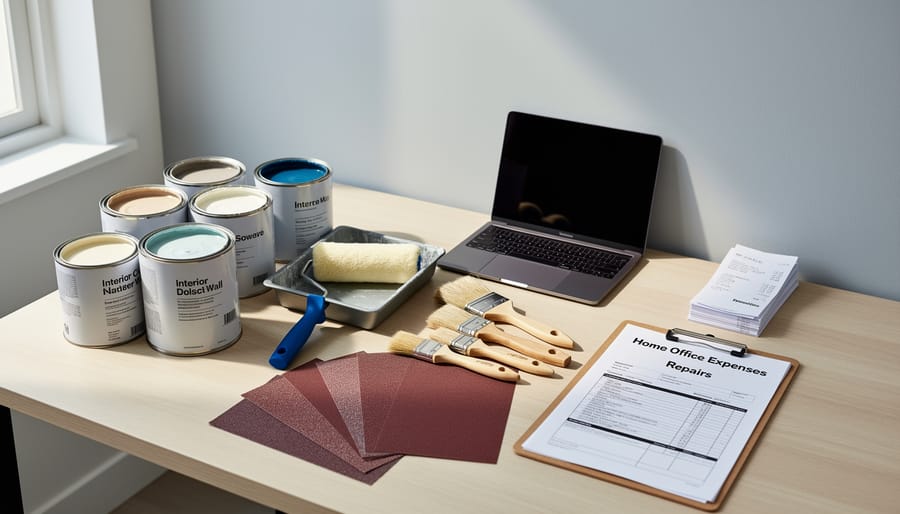
The difference between a repair and an improvement matters enormously come tax time. Get it right, and you can deduct the full cost immediately. Get it wrong, and you’ll spread that deduction over decades through depreciation.
A repair restores something to its previous condition without adding value or extending its useful life. Think patching a leaky roof, fixing a broken furnace, or replacing cracked windows with comparable ones. These expenses maintain what you already have, and you can deduct your business-use portion in the year you pay them.
An improvement, on the other hand, adds value, extends the property’s useful life, or adapts it to a new use. Installing a new roof when the old one still has years left, upgrading to a high-efficiency HVAC system, or finishing a basement to create office space all count as capital improvements. You can’t deduct these costs immediately. Instead, you depreciate them over many years as part of your property’s capital cost allowance.
The CRA looks at whether the work was necessary to keep the property functional or whether it made the property better than before. Replacing a few shingles after storm damage is a repair. Re-roofing the entire house because you want a premium metal roof is an improvement, even if the old roof leaked occasionally.
For small business owners, this distinction affects your cash flow directly. If you spend $5,000 on furnace repairs and correctly classify it as maintenance, you might see $1,500 back in tax savings this year. Misclassify that same expense as an improvement, and you’ll recover those dollars at perhaps $50 annually over thirty years.
When in doubt, document your reasoning. Photograph the damage or problem before the work, keep detailed invoices describing what needed fixing, and note whether you replaced items with equivalent or upgraded versions.
Calculating Your Business-Use Percentage
Calculating your business-use percentage accurately is essential for claiming the right amount of home maintenance expenses. The CRA accepts two main calculation methods, and you should choose the one that best reflects your actual business use.
The most common approach is the square footage method. Here’s how to calculate it:
- Measure the total square footage of your home, including all finished living spaces
- Measure the square footage of the space you use exclusively for business
- Divide your business space by your total home space
- Multiply by 100 to get your percentage
For example, if your home office occupies 150 square feet in a 1,500 square-foot home, your business-use percentage is 10 percent (150 ÷ 1,500 = 0.10).
Alternatively, you can use the number-of-rooms method if your rooms are roughly equal in size. Simply divide the number of rooms used for business by the total number of rooms in your home.
Keep in mind that the CRA requires “exclusive use” for these spaces. If your dining room doubles as your office, you can only claim the hours it’s used for business divided by total hours in the year. This makes the calculation more complex and harder to defend, so dedicated business space is preferable.
Once you’ve determined your percentage, apply it to eligible maintenance expenses like furnace repairs, roof maintenance, or exterior painting. If you spend $1,000 on furnace repairs and your business-use percentage is 10 percent, you can claim $100 as a business expense.
Special Considerations for Farmers and Rural Property Owners
Farmers and rural business owners face unique opportunities, and complexities, when it comes to home maintenance tax planning. Unlike urban home-based businesses, farm operations often involve multiple structures and extensive property where the line between personal and business use isn’t always clear-cut.
Farm buildings present the most straightforward claims. Barns, equipment sheds, greenhouses, and processing facilities used exclusively for your farming operation qualify for full maintenance expense deductions. When you repair a dairy barn roof or replace worn siding on a machine shed, these costs are business expenses, plain and simple. Keep separate records for these structures to simplify your tax preparation.
Outbuildings that serve dual purposes require more careful calculation. A garage that houses both farm equipment and personal vehicles needs the same proportional approach you’d use for a home office. If 70% of the space stores business assets, you can claim 70% of maintenance costs like roof repairs, painting, or foundation work.
Property maintenance becomes deductible when it directly supports your farming operation. Maintaining laneways that provide access to fields or barn areas qualifies. Clearing drainage ditches that protect crop land or keeping fences in good repair for livestock operations are legitimate business expenses. However, landscaping around your residence or maintaining purely decorative features remains personal.
Septic systems and wells on farm properties often serve both the home and the operation. If your processing facility or employee washroom connects to your septic system, calculate the business portion based on usage. A well that supplies water to livestock, irrigation systems, and your home requires a reasonable allocation between business and personal use.
The key is establishing a clear, defensible method for splitting costs. Document which structures and systems serve your farm operation, calculate business-use percentages consistently, and apply the same methodology year after year. This consistency demonstrates good faith to the CRA and simplifies your annual tax preparation.
Record-Keeping Best Practices for Home Maintenance Deductions
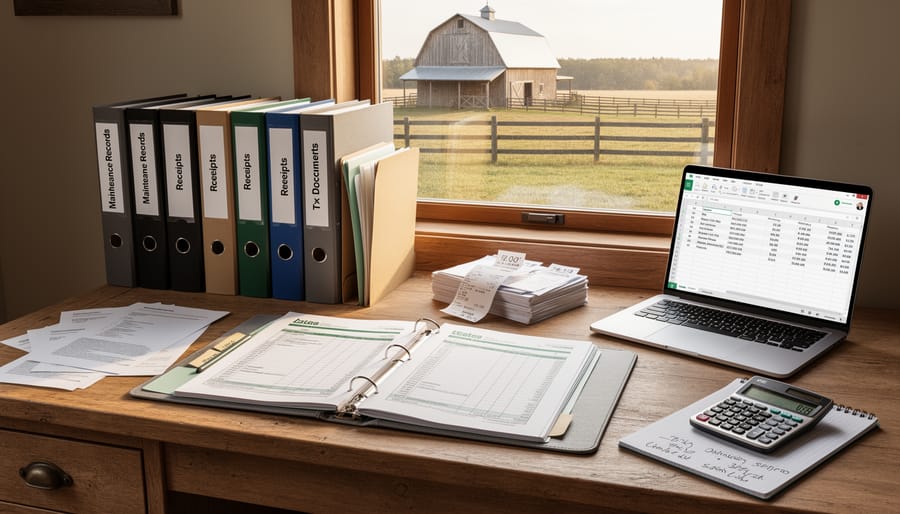
Proper documentation transforms legitimate expenses into defensible deductions. The CRA expects you to prove every claim, which means establishing a system now saves headaches later.
Start by maintaining separate records for each maintenance expense. Keep every receipt, invoice, and contract related to home repairs and maintenance work. Digital copies work just as well as paper, take photos of receipts immediately and store them in a dedicated folder on your phone or computer. Many receipts fade over time, so digitizing protects your documentation.
Create a simple spreadsheet or use basic accounting software to log each expense as it happens. Record the date, vendor name, amount, description of work, and the business-use percentage you’re applying. This running log becomes invaluable when tax season arrives, eliminating the scramble to reconstruct months of spending from memory.
For contractors and service providers, keep detailed invoices that specify what work was performed. A receipt showing “$500 to John’s Handyman Service” won’t satisfy CRA requirements. You need documentation that states “replaced leaking kitchen faucet” or “repaired broken garage door spring.” If an invoice lacks detail, add notes yourself about what was done and why it was necessary.
Document your business-use calculation and keep it consistent from year to year. Measure your workspace, photograph it, and file these measurements with your tax records. Changing your claimed percentage significantly without explanation invites questions.
Bank and credit card statements provide supporting evidence but don’t replace proper receipts. They confirm you spent money but don’t prove what you purchased or whether it qualifies as a business expense.
Set a monthly reminder to review and organize your documentation. Fifteen minutes each month beats spending hours reconstructing records at year-end, and consistent habits make tracking second nature.
Common Mistakes That Trigger CRA Red Flags
The CRA scrutinizes home office and maintenance claims more carefully than many other business deductions, and certain patterns consistently trigger reviews. Understanding these red flags helps you claim legitimate expenses confidently while avoiding unnecessary attention.
Claiming 100% of Any Home Expense
One of the fastest ways to invite scrutiny is claiming the full cost of any home-related expense when you share the space with your family. The CRA expects you to split costs between personal and business use based on your business-use percentage. Claiming your entire utility bill, property tax amount, or insurance premium signals either misunderstanding or intentional overclaiming. Always apply your calculated business-use percentage to shared expenses, if your home office represents 15% of your home’s square footage, you can claim 15% of eligible costs, not a penny more.
Mixing Up Repairs and Capital Improvements
Treating a major renovation as a current-year repair expense is a common error that raises immediate concerns.
The distinction matters because repairs get deducted immediately while improvements must be depreciated over years. When you claim an unusually large “repair” expense in a single year, it suggests you may not understand the rules, or you’re hoping the CRA won’t notice.
Inadequate or Missing Documentation
Many business owners lose legitimate deductions simply because they can’t prove the expense when asked. Receipts that say “hardware store, $347” without details about what you purchased won’t support your claim. The CRA wants to see itemized receipts, invoices from contractors with clear descriptions of work performed, and your own notes explaining how each expense relates to your business space. Keep records for at least six years and store them where you can find them quickly.
Inconsistent Business-Use Calculations
Changing your business-use percentage significantly from year to year without a clear reason, like moving to a larger office space or expanding your operation, suggests the calculation isn’t based on actual measurement. Pick a consistent, defensible method and stick with it unless your circumstances genuinely change.
Planning Your Maintenance Schedule Around Tax Strategy
Timing your home maintenance can make a significant difference in your tax situation. When you understand your fiscal year and current income, you can schedule repairs strategically to maximize deductions when they’ll provide the greatest benefit.
If you’re expecting higher income this year, accelerating necessary repairs before December 31st increases your deductions when you need them most. Conversely, if next year looks more profitable, deferring non-urgent maintenance into January can shift those deductions forward. This approach to year-end planning ensures your maintenance spending aligns with your overall tax strategy.
Consider bundling smaller repairs into a single year rather than spreading them across multiple tax years. If you’re planning several projects, completing them within the same fiscal period consolidates your deductions for stronger tax impact. For capital improvements that must be depreciated, timing the completion date determines when you start claiming those deductions.
Review your home maintenance needs each fall. Create a list of required repairs, estimate costs, and assess which projects offer the best tax timing based on your projected income. This proactive approach helps you save before year-end while maintaining your property effectively.
Don’t rush into unnecessary work just for tax purposes, but when legitimate maintenance is needed, strategic scheduling transforms routine expenses into well-timed deductions that support your business finances.
Home maintenance tax planning offers genuine opportunities to reduce your tax burden while keeping your property in good condition. The key is consistent tracking, log every repair, utility payment, and maintenance expense throughout the year, not just at tax time. This habit ensures you never leave deductions on the table.
Getting the details right matters. Distinguishing repairs from improvements, calculating your business-use percentage accurately, and maintaining proper documentation all determine whether your claims stand up to CRA review. When you’re running a business, finding time for these details can be challenging.
That’s where smart tax consulting makes a difference. Professional support through a national network gives you affordable access to experts who understand both home-based business deductions and CRA requirements. They can integrate your property expenses into a broader personal tax plan that maximizes benefits while minimizing risk.
Focus your energy on growing your business. Let experienced professionals handle the tax details, ensuring you claim every legitimate deduction without triggering red flags.