 darin
darin Managing your books and paying your team shouldn’t require two different software platforms, multiple data entries, or separate monthly fees. The right small business accounting and payroll software handles both functions in one place, ensures CRA compliance for Canadian tax requirements, and typically costs between $20 and $75 per month depending on your business size and needs.
For Canadian entrepreneurs, the buying decision comes down to three core factors: whether the software automatically calculates CPP, EI, and provincial tax deductions; how easily it connects your payroll expenses to your financial reports; and whether the pricing structure fits your actual employee count. Many business owners overspend on enterprise features they’ll never use or choose free accounting tools only to discover payroll costs them more in the long run.
The market has shifted considerably. Integrated platforms now dominate because they eliminate the reconciliation headaches that come from running separate systems. When your payroll data flows directly into your profit and loss statement, you spend less time on bookkeeping and more time running your business. This integration also makes it easier to save more taxes through accurate expense tracking and proper payroll deduction management.
This guide walks you through the key selection criteria, compares the main software types available to Canadian small businesses, provides current recommendations with verified 2026 pricing, and highlights the common mistakes that cost business owners time and money. Whether you’re hiring your first employee or switching from a system that no longer serves you, you’ll find practical, cost-effective solutions designed for the realities of running a small enterprise in Canada.
What to Look for in Small Business Accounting and Payroll Software
Canadian Payroll Compliance and Tax Filing

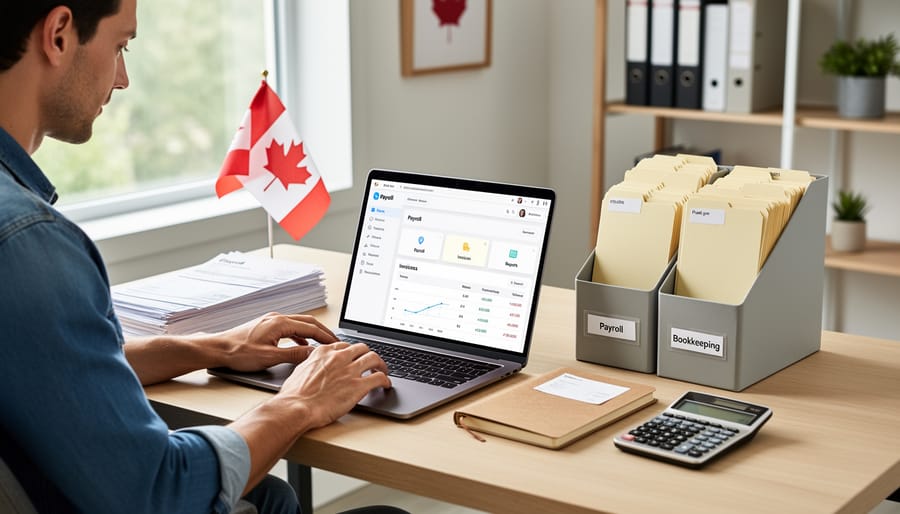
Running payroll in Canada means navigating a maze of federal and provincial tax requirements. Every pay period, you need to calculate CPP and EI contributions accurately, withhold income tax at the correct rates, and track everything for monthly or quarterly remittances to the CRA. Miss a deadline or miscalculate a deduction, and you’re facing penalties that can seriously hurt a small operation.
Software with automatic Canadian payroll compliance handles these calculations for you, applying current tax tables and adjusting for provincial variations without you needing to look up rates or formulas. It generates the remittance forms, tracks your obligations, and often files directly with the CRA on your behalf. That means no spreadsheet errors, no missed deadlines, and no need to hire a payroll specialist or spend hours deciphering tax guides.
For farmers, tradespeople, and other entrepreneurs running lean teams, this automation is essential. You can pay your employees confidently, knowing the deductions are correct and the filings will happen on time, while you focus on the work that actually grows your business.
Accounting Integration and Data Flow
When payroll runs separately from your bookkeeping, you’re entering the same wage, tax, and benefit figures twice, once in payroll and again in your accounting ledger. This duplication wastes time and creates opportunities for costly errors that can throw off your financial reports and tax filings.
Software that connects payroll directly to your accounting system automatically transfers employee wage expenses, payroll taxes, and deductions into the correct accounts. When you process a pay run, the system posts those costs to your general ledger without manual entry. This connection ensures your profit and loss statements reflect current labour costs, and your balance sheet tracks payroll liabilities accurately.
For Canadian small business owners managing their own books, integrated data flow means you can see the full financial picture in one place. You’ll know exactly how much you’ve spent on wages this month, track CPP and EI remittances against what you owe, and close your books faster at month-end. The payroll entries appear in your accounting records immediately, eliminating the gap where you’re unsure whether you’ve accounted for the last pay period.
Look for software where payroll syncs automatically with your chart of accounts, or choose an all-in-one platform where payroll and bookkeeping share the same database. Either approach cuts the double-handling that slows you down and introduces mistakes.
Ease of Use for Non-Accountants
Most small business owners in Canada haven’t studied accounting, and they shouldn’t need to. The software you choose must work for someone running a farm, managing a construction crew, or operating a retail shop, people who need to process payroll and track expenses between customer appointments or after a long day in the field. Look for platforms with clean dashboards that show your cash position at a glance, guided workflows that walk you through payroll runs step-by-step, and plain-language labels instead of technical accounting terms. Features like automatic tax calculations and one-click invoice creation save hours and prevent costly errors. If you find yourself constantly searching help documentation or calling support just to complete routine tasks, the software is too complex for your needs.
Types of Accounting and Payroll Software for Small Enterprises
All-in-One Platforms
All-in-one platforms bundle accounting, invoicing, expense tracking, and payroll into a single interface. This eliminates the hassle of syncing separate tools or re-entering employee hours and tax deductions across different systems. For solopreneurs managing their own books and a handful of employees, a unified platform means less time switching between apps and fewer opportunities for data entry mistakes.
QuickBooks Canada leads this category as the #1 small business accounting and bookkeeping software. It tracks expenses, creates invoices, accepts payments, and runs payroll online. The Auto payroll feature makes paying employees quick, easy, and accurate, which matters when you’re juggling client work and administrative tasks. Sage Business Cloud Accounting offers Canadian plans at three tiers, Start, Standard, and Plus, with pricing at $23, $50, and $72 per month plus tax depending on the features you need. This tiered approach lets you start small and add capabilities as your team grows.
All-in-one solutions work best when your business needs centralized financial records and you want one login for everything. They reduce the learning curve for non-accountants and keep all your financial data in one place for faster tax prep and better oversight.
Standalone Payroll Services
Standalone payroll services concentrate solely on employee compensation and tax compliance, making them an efficient choice when you already have accounting software handling your bookkeeping. These dedicated tools excel at processing paycheques, calculating deductions, and filing required remittances with the CRA without the overhead of full accounting features you might not need.
The main advantage is specialization. Because these platforms focus exclusively on payroll, they often handle complex scenarios like hourly workers, overtime calculations, and multiple pay schedules more robustly than add-on modules. Wave Payroll exemplifies this approach at $20 per month plus $6 per payee, delivering automatic payroll tax calculations and filing without requiring you to switch your entire bookkeeping system.
These services typically integrate with popular accounting platforms through direct connections or standard exports, letting payroll data flow into your general ledger without manual re-entry. This setup works particularly well for businesses that have outgrown basic accounting-only tools but aren’t ready to migrate their entire financial operation to a new all-in-one system. If your bookkeeping process already functions smoothly, adding a specialized payroll service preserves that stability while gaining professional-grade employee payment capabilities.
Accounting Software with Payroll Add-Ons
Modular software lets you start with basic bookkeeping and add payroll when you hire your first employee. This approach works well if you’re a solopreneur now but plan to grow. You keep your accounting system intact and simply activate payroll functionality when needed, rather than switching platforms mid-year.
Most accounting platforms offer payroll as an optional upgrade. You’ll typically pay your base accounting subscription, then add a monthly payroll fee once you have staff. For example, Sage’s Canadian plans start at $23 per month for core accounting, with payroll available as a separate add-on at higher tiers. This structure means you’re not paying for features you don’t use yet.
The main advantage is familiarity. You learn one system for invoicing and expense tracking, then extend that same interface to handle employee payments. Your chart of accounts, bank connections, and workflows stay consistent. The risk is that payroll add-ons sometimes lag behind dedicated services in features or automation, so confirm the module handles Canadian tax filing properly before you commit. Test whether the add-on truly integrates or just bolts on as a separate tool that requires duplicate entry.
Top Software Options for Canadian Small Businesses in 2026
QuickBooks Canada

QuickBooks Canada holds the #1 position among small business accounting and bookkeeping solutions in the Canadian market, and that standing reflects its comprehensive feature set. The platform handles expense tracking, invoice creation, payment processing, and online payroll administration from a single dashboard, eliminating the need to juggle multiple systems or manually transfer data between separate tools.
For Canadian entrepreneurs managing employees, QuickBooks’ Auto payroll feature stands out as a significant time-saver. This functionality makes paying your team quick, easy, and accurate by automating calculations for CPP, EI, and provincial tax deductions according to current Canadian regulations. Instead of spending hours each pay period verifying amounts and filing requirements, you initiate payroll runs with a few clicks while the software handles compliance details in the background.
The platform suits businesses that want everything in one place: farmers invoicing clients for services rendered, tradespeople tracking job costs and materials, service providers accepting online payments, or retail operations managing inventory alongside payroll. QuickBooks scales with your operation, accommodating additional users and more complex reporting as your team grows, which means you won’t outgrow the system after your first few hires.
Sage Business Cloud Accounting
Sage Business Cloud Accounting offers three Canadian plans designed to scale with your business. Start runs $23 per month before tax and handles core bookkeeping tasks like invoicing and expense tracking, a solid entry point for solopreneurs or single-person operations just getting organized. Standard jumps to $50 monthly and adds multi-currency support plus stronger reporting tools, making it suitable once you’re juggling multiple income streams or working with suppliers outside Canada. Plus sits at $72 per month and brings advanced features like project costing and workflow approvals, built for established businesses with dedicated staff or multiple locations.
The tiered structure lets you begin at a level that matches your current reality rather than paying for capabilities you won’t use. A tradesperson launching from home typically finds Start sufficient, while a growing service business with three employees and inventory might benefit from Standard’s expanded reporting. Plus makes sense when complexity increases, you’re managing several concurrent projects, need detailed job costing, or require multiple users accessing the system. Sage delivers Canadian tax compliance across all tiers, so your choice hinges on operational needs rather than fundamental functionality gaps.
Wave Payroll
Wave Payroll stands out as the most budget-friendly option for Canadian small businesses with straightforward payroll requirements. At $20 per month plus $6 per payee, it delivers essential payroll processing at a fraction of what comprehensive accounting platforms charge. This pricing structure works particularly well for solopreneurs with one or two employees, or seasonal businesses that don’t need year-round full-service accounting.
The service handles automatic payroll tax calculations and filing for Canadian requirements, removing the compliance burden that often overwhelms new employers. You don’t need accounting expertise to run accurate payroll or submit remittances on time. Wave processes CPP, EI, and income tax deductions correctly, then files them with the CRA on your behalf.
However, Wave Payroll functions as a standalone service rather than an integrated all-in-one platform. If you already use Wave’s free accounting software or another bookkeeping system, this creates a streamlined pairing. For businesses that need robust expense tracking, invoicing, and financial reporting alongside payroll, QuickBooks or Sage might offer better value despite higher costs. Wave excels when your primary need is paying a small team correctly and affordably, not managing complex financial operations.
Other Solutions Worth Considering
While QuickBooks, Sage, and Wave dominate the Canadian small business market, several specialized platforms serve particular niches effectively. Xero offers strong multi-currency support and inventory management, making it ideal for product-based businesses that sell internationally or manage complex stock levels. The platform’s bank reconciliation features and third-party app ecosystem appeal to growing companies that need customization.
Wagepoint focuses exclusively on Canadian payroll processing with straightforward per-employee pricing and excellent customer support. It’s particularly suited to service businesses and professional firms that need reliable payroll but handle accounting separately through their own bookkeeper or accountant.
FreshBooks targets service providers, consultants, and contractors who prioritize time tracking and client invoicing over detailed financial reporting. Its project-based accounting works well for businesses billing by the hour or project milestone.
Rise provides payroll and HR tools designed specifically for restaurant and hospitality operations, addressing shift scheduling and tip management alongside standard payroll functions.
These niche solutions often excel in their specialized areas but may require integration with separate accounting software, adding complexity and cost. Evaluate whether the specialized features justify managing multiple platforms versus choosing an all-in-one solution.
How to Match Software to Your Business Type
Your business type and operational model directly influence which accounting and payroll software will serve you best. A seasonal farm with fluctuating employee counts needs different features than a year-round trades company with a stable crew, and both differ from a service business managing contractors rather than employees.
Farmers and agricultural businesses face unique challenges: seasonal hiring peaks, equipment depreciation tracking, and managing both employee wages and contractor payments during harvest. QuickBooks Canada handles this complexity well with its comprehensive expense tracking for farm equipment and supplies alongside flexible payroll that scales up or down with seasonal staff. The ability to categorize costs by crop or livestock type helps at tax time. If you run a simpler operation with just a few year-round employees, Wave Payroll at $20 per month plus $6 per active employee offers enough functionality without paying for features you won’t use.
Tradespeople, electricians, plumbers, HVAC technicians, typically employ skilled workers at varying hourly rates and need to track labour costs per job. Look for software that connects time tracking to specific projects and integrates those hours directly into payroll. QuickBooks and Sage both excel here, letting you bill clients accurately while paying employees correctly for each job site. This prevents the common headache of manually reconciling timesheets with payroll and project costs.
Service providers and consultants who work primarily with contractors rather than employees require simpler payroll capabilities but robust invoicing and expense management. Consider whether you actually need full payroll, or if accounting software with strong contractor payment features suffices. Sage’s Standard plan at $50 per month handles contractor tracking well without the overhead of employee payroll.
Your employee structure matters as much as your industry:
– Businesses with 1-5 employees in a single province can use streamlined solutions like Wave Payroll
– Companies with 6-20 employees across multiple provinces need robust multi-jurisdictional payroll found in QuickBooks or Sage Plus
– Businesses mixing employees and contractors require platforms that handle both payment types without duplicate data entry
– Seasonal operations benefit from software charging per active employee rather than fixed team sizes
Retail businesses with point-of-sale systems should prioritize software that integrates with their existing POS hardware and daily sales tracking. QuickBooks connects with most major POS systems, automatically importing sales data and syncing employee hours from time clock integrations. This eliminates evening reconciliation work and keeps your books current without manual input.
Common Mistakes to Avoid When Choosing Software
Choosing the wrong accounting and payroll software can cost you time, money, and compliance headaches down the road. Many Canadian small business owners rush the decision or focus on the wrong criteria, leading to costly mistakes.
The most common error is selecting software based solely on the lowest price. A $10-per-month solution might look attractive initially, but if it can’t handle Canadian payroll tax calculations or requires you to purchase multiple add-ons, you’ll end up spending more while creating extra work. Compare total costs including payroll modules, tax filing features, and any transaction fees before committing.
Another frequent mistake is underestimating how quickly your business will grow. Many entrepreneurs choose software perfect for their current situation without considering whether it can scale as they add employees, expand operations, or open additional locations. Starting with a solution that accommodates reasonable growth saves you the disruption and expense of switching platforms later.
Ignoring integration needs creates unnecessary headaches. If you already use specific tools for invoicing, point-of-sale, or inventory management, choose accounting and payroll software that connects with those systems. Otherwise, you’ll spend hours manually transferring data between platforms, increasing the risk of errors.
Perhaps the biggest mistake is skipping the trial period. Most platforms offer free demos or trial periods, use them. Test the actual workflows you’ll perform regularly: running payroll, generating reports, filing tax remittances. What looks simple in a sales video might prove confusing when you’re trying to process your first payroll at midnight before payday. Take time to explore the interface, check whether the support documentation makes sense, and confirm the software actually handles your specific business type before you commit.
What to Look For

When evaluating accounting and payroll software, focus on features that directly impact your day-to-day operations and long-term compliance. Canadian tax requirements should top your list, the software must handle CPP, EI, and provincial payroll calculations automatically, plus file remittances without requiring you to become a tax expert.
Integration matters more than most business owners initially realize. Your accounting and payroll systems need to share data seamlessly, whether they’re part of one platform or separate tools that connect. This eliminates double entry and the errors that come with it.
Ease of use determines whether you’ll actually use the software properly. If the interface confuses you during the trial, it won’t get easier under deadline pressure. Look for clear dashboards, straightforward employee setup, and simple month-end processes.
Scalability often gets overlooked until it’s too late. A solution that works for you as a solopreneur should accommodate hiring your first three employees without forcing a complete platform switch. Check what adding users or payees will cost before you commit.
Finally, true cost extends beyond the monthly fee. Factor in transaction charges, support costs, accountant access fees, and year-end filing services when comparing options.
Main Options Compared
Canadian small businesses typically choose among three main approaches when selecting accounting and payroll software. All-in-one platforms like QuickBooks combine bookkeeping, invoicing, expense tracking, and integrated payroll in a single system. These comprehensive solutions work well for entrepreneurs who want everything under one roof, though they generally cost more upfront. Pricing for full-featured platforms typically ranges from $50 to $80 monthly depending on features and employee counts.
Standalone payroll services focus exclusively on paying employees and managing tax compliance. Wave Payroll exemplifies this category at $20 monthly plus $6 per payee, offering automatic tax calculations and filing without the broader accounting features. This option suits businesses already using separate bookkeeping software or working with a financial consultant advice.
Modular accounting software with add-on payroll capabilities represents the middle ground. Sage’s tiered approach starts at $23 monthly for basic accounting, letting you add payroll later as your team grows. This flexibility helps control costs while building toward comprehensive functionality. The right choice depends on your current needs, budget constraints, and whether your priority is simplifying operations or working strategically to cut your tax bill through better financial data.
Frequently Asked Questions
Can one person manage both accounting and payroll without special training?
Yes, modern integrated platforms are designed for entrepreneurs without accounting backgrounds. QuickBooks Canada’s Auto payroll feature and similar tools from other providers make employee payments quick and accurate, while built-in compliance features handle tax calculations automatically.
How much should I budget monthly for accounting and payroll software?
Budget between $20 and $75 per month depending on your business complexity. Wave Payroll starts at $20 a month plus $6 per payee, while Sage’s Canadian plans range from $23 to $72 plus tax per month. Factor in per-employee fees if you’re running payroll for multiple staff members.
Do I need separate software for contractors versus employees?
No, most platforms handle both within the same system. The software will track contractor payments separately and issue T4A slips at year-end, while employee payments receive T4s and full payroll tax processing.
What happens if I operate in multiple provinces?
Look for software that manages multi-provincial payroll tax rates automatically. Quality Canadian platforms adjust CPP, EI, and provincial tax deductions based on where each employee works, ensuring compliance across jurisdictions without manual calculations.
Most Canadian entrepreneurs find that switching between platforms becomes easier when they plan the transition around their fiscal year-end. Export your data from the old system before the final year-end close, then run both systems in parallel for one pay period to verify accuracy. This approach minimizes disruption while ensuring nothing falls through the cracks during tax season.
Bank integration deserves careful attention during setup. Direct connections between your financial institution and your accounting software eliminate manual transaction entry and speed up reconciliation. Most major Canadian banks support feeds to popular platforms, though you may need to enable business banking features or API access through your branch. Test the connection with a few transactions before relying on it completely.
The year-end filing process varies by platform, but integrated solutions simplify the work considerably. Your software should generate T4 and T4A slips automatically, calculate annual totals for CRA remittances, and provide summarized reports for your accountant. Starting your tax planning before year-end gives you time to address any discrepancies and ensures your records align with what you’ll report to the government.
Remember that switching costs include more than just subscription fees. Factor in the time needed to learn a new interface, migrate historical data, and adjust your bookkeeping routines. Many providers offer free trials that let you test the system with real transactions before committing, which reduces the risk of choosing software that doesn’t match your workflow.
Choosing the right accounting and payroll software isn’t about finding the most expensive or feature-packed platform. It’s about selecting a practical tool that handles Canadian compliance automatically, saves you time, and scales as you grow. Whether you’re managing a farm, running a trade business, or building a service company, the solutions reviewed in this guide offer proven ways to stay on top of bookkeeping and payroll without hiring specialist staff.
Start by assessing your current needs and where you expect to be in two years. Take advantage of free trials to test interfaces and workflows before committing. If you’re unsure which features matter most for your situation, lean on your accountant or professional network for guidance, especially when coordinating your software choice with your personal tax plan.
The right software frees you to focus on what you do best: serving customers, growing revenue, and building a sustainable business across Canada.