
 darin
darin Valuing your small business for tax planning in Canada is a multi-step process that combines documentation review, financial analysis, and the application of one or more recognized valuation methods to establish a defensible fair market value. This value becomes the foundation for optimizing your tax position, particularly when claiming the lifetime capital gains exemption, which can shelter up to $1,016,836 of qualifying gains in 2026. Getting the valuation right matters because the Canada Revenue Agency scrutinizes these numbers closely, and an unsupported figure can trigger reassessments, penalties, and lost tax savings.
Most small business owners underestimate how much preparation goes into a credible valuation. You need three to five years of financial statements, corporate tax returns, shareholder agreements, and a clear picture of your business structure before any valuation method can be applied. The process typically takes four to eight weeks when working with a professional valuator, though simpler operations may move faster.
The stakes are high. Tax planning around a business sale or succession isn’t something you can reverse easily once executed. Timing your valuation correctly, ensuring your shares qualify for preferential treatment, and documenting your assumptions properly can mean the difference between paying full capital gains tax and walking away with hundreds of thousands of dollars more in your pocket. Understanding what your business is worth gives you the clarity to structure transactions, freeze values at optimal moments, and plan income splitting strategies with confidence.
Why Business Valuation Matters for Tax Planning

Knowing your business value before you list it for sale isn’t just helpful, it’s essential for minimizing your tax bill. The difference between a hasty sale and a well-planned exit can mean tens or even hundreds of thousands of dollars in tax savings, depending on your business size and structure. Most small business owners focus on finding a buyer at the right price, but the real money is made or lost in how you structure the transaction, and that requires knowing what you’re actually worth.
The lifetime capital gains exemption represents the single biggest tax advantage available to Canadian business owners. For 2026, the LCGE may apply to qualifying small business corporation shares, potentially sheltering over $1 million in capital gains from tax. But here’s the catch: you need to prove your shares qualify throughout your ownership period, and that means understanding your business value at multiple points in time. If your company holds too many non-operating assets relative to its active business value, you could lose eligibility entirely. Valuing your business early gives you time to fix these issues through purification strategies before you need to sell.
Beyond the exemption, valuation affects how the CRA treats your proceeds. Sell too quickly without documentation and you risk having gains recharacterized as business income taxed at your full marginal rate instead of the preferential capital gains rate. A proper valuation establishes that you’re disposing of a capital asset, not just liquidating inventory or goodwill that gets taxed as income. This distinction matters even more when you’re selling assets versus shares, since each approach carries different tax consequences for both you and the buyer.
Early valuation also reveals planning opportunities you can’t access once the sale process starts. If your business value comes in lower than expected, you have time to improve operations or defer the sale. If it’s higher, you can structure earn-outs, holdbacks, or phased transactions that spread tax liability across multiple years. You might discover that selling now triggers a higher tax bracket, but waiting six months puts you in a better position. These choices disappear once you’ve committed to a buyer and a timeline.
What You Need to Value Your Business
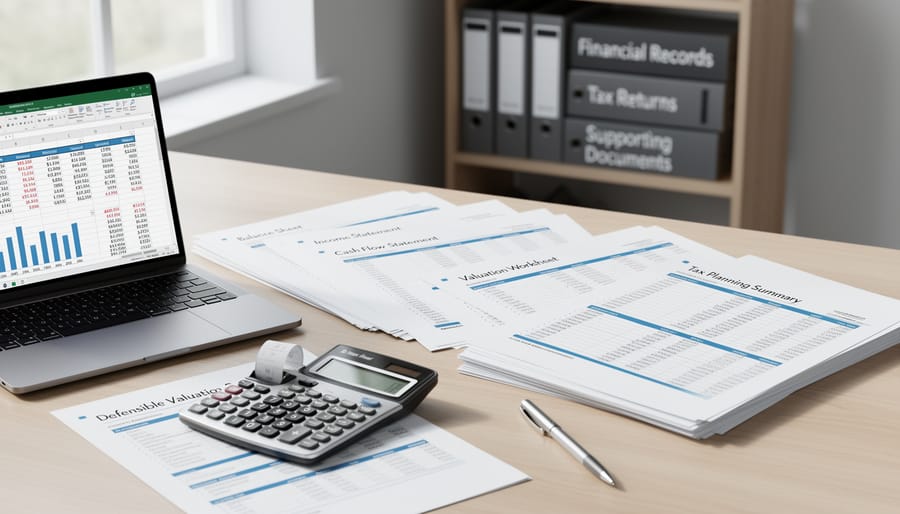
Financial Documents
Gather at least three years of complete financial statements to establish value trends and demonstrate business stability. You’ll need year-end balance sheets showing your assets, liabilities, and owner’s equity position at each period end. Income statements (profit and loss statements) for the same periods reveal your revenue patterns, expense structure, and profitability trends that directly impact valuation calculations.
Pull your corporate tax returns (T2) and any provincial returns for the past three years. These verify the income reported in your financial statements and show how you’ve treated deductions, capital cost allowance, and shareholder transactions. If you’ve prepared internal monthly or quarterly statements, include those as well, they help valuators spot seasonal patterns and recent performance shifts.
Cash flow statements matter more than many owners realize. They show whether your profits translate into actual cash generation, which affects how buyers and tax advisors assess sustainable earnings. If your accountant hasn’t prepared formal cash flow statements, basic bank reconciliations and cash position summaries work as starting points.
Include any notes to financial statements explaining accounting policies, significant transactions, or unusual items that could skew year-over-year comparisons.
Operational Records
Beyond financial statements, you’ll need operational documents that prove your business runs smoothly and has transferable value. These records demonstrate the stability and future potential buyers or the CRA may scrutinize during a sale.
Start with customer documentation. Gather contracts, recurring service agreements, and client lists showing revenue concentration. If three customers generate 80% of your income, that affects value and tax planning options.
Compile supplier agreements, particularly exclusive arrangements or favorable pricing terms that transfer to a new owner. These can justify higher valuations. Include lease agreements for premises and equipment, remaining lease terms and renewal options directly impact business continuity.
Document your workforce through employment contracts, collective agreements, and organizational charts. Key employee retention agreements add value, while significant turnover issues reduce it.
Collect intellectual property records: trademarks, patents, proprietary processes, trade secrets, and brand assets. Even a simple customer database or specialized workflow can constitute valuable IP.
Finally, gather licenses, permits, and regulatory approvals required to operate. Some aren’t transferable, which affects both valuation and sale structure. Knowing this early lets you address issues before listing the business.
Important Considerations Before You Start
Before you dive into valuing your business, understand that several factors can undermine your results or create tax complications down the road. Getting these fundamentals right now saves you from costly mistakes later.
Timing Is Everything
Start your valuation at least 12 to 18 months before you plan to sell. This lead time gives you room to implement tax planning strategies, address value gaps, and qualify for capital gains treatment. Rushing through a valuation weeks before listing your business eliminates most tax optimization opportunities and forces you to accept whatever tax position you’re currently in.
Many business owners lose QSBC eligibility by holding too many passive investments or real estate inside the corporation. If your company holds excess cash, marketable securities, or rental properties, you may need to purify the corporation before selling. This process takes time and must be completed well before the sale closes.
Don’t Overvalue Based on Emotion
The biggest valuation mistake is letting personal attachment inflate your numbers. Your business may be worth more to you than to a buyer, but tax planning requires realistic market values. Using inflated figures creates problems when CRA reviews your capital gains treatment or when actual buyers present lower offers.
Professional Support Matters
While you can conduct preliminary valuations yourself, complex situations demand professional input. If your business exceeds $500,000 in value, operates in multiple provinces, holds significant real estate, or has complicated shareholding structures, get an accountant involved early. This ties directly into your broader year-end tax planning, where valuation insights help shape your overall tax strategy for the current year and beyond.
Skipping professional review risks missing purification requirements, misapplying valuation methods, or triggering attribution rules that convert capital gains into ordinary income.
Step-by-Step: How to Value Your Business for Tax Planning
Step 1: Choose the Right Valuation Method
The valuation method you choose depends on your business type, industry, and what drives its value. Most small Canadian businesses use one of three approaches, and many accountants combine methods to cross-check results.
Asset-based valuation works best for businesses where value sits in tangible assets rather than ongoing profits. This method adds up what you own, equipment, inventory, real estate, vehicles, and subtracts liabilities. It suits manufacturing operations with significant machinery, retail businesses with substantial inventory, or companies planning to liquidate. The limitation: it ignores your customer relationships, brand reputation, and future earning potential.
Income-based valuation (multiple of earnings) fits most service businesses, professional practices, and companies where profit drives value. You take normalized earnings, typically EBITDA or seller’s discretionary earnings after removing one-time expenses and owner perks, and multiply by an industry factor. A profitable consulting firm might use 2-3 times earnings, while a stable distribution business could command 4-5 times. This method reflects what buyers actually pay for cash flow.
Market-based comparisons use recent sales of similar businesses to estimate value. You compare your revenue, profit margins, and growth to businesses that sold recently in your sector. This approach grounds your valuation in reality but requires access to comparable sale data, which can be hard to find for small private companies.
For tax planning purposes, your accountant may use the method that produces the most defensible result for CRA scrutiny while optimizing your capital gains treatment.
Step 2: Calculate Your Business Value
Once you’ve selected your valuation method, it’s time to run the numbers. Start by gathering your normalized financial data, typically three to five years of financial statements that reflect your actual business performance. Remove one-time expenses like that major equipment repair in 2024 or the bonus you paid yourself when revenue spiked. These adjustments show what a buyer would actually earn running the business under normal conditions.
Next, identify and separate non-operating assets. That cottage property you hold in the company or the investment account sitting on your balance sheet aren’t part of the core business value. List these separately because they often receive different tax treatment and shouldn’t inflate your operating business multiple.
Apply your chosen method to the normalized figures. If you’re using a multiple of earnings approach with a 2.5x multiple and your normalized annual profit is $180,000, your baseline operating value is $450,000. Add back the market value of non-operating assets separately.
Calculate a realistic range, not a precise number. Market conditions, buyer motivation, and economic factors all affect final sale prices. A reasonable range for most small businesses spans 15-20% above and below your calculated midpoint. For the example above, you’d present a range of $382,500 to $517,500 for the operating business.
This range gives you flexibility in tax planning while keeping expectations grounded in defendable calculations.
Step 3: Identify Tax Planning Opportunities
With your business value established, you can now pinpoint specific ways to reduce tax on the sale. This is where valuation moves from number-crunching to actual money saved.
Start by checking if your business qualifies for the lifetime capital gains exemption. For 2026, this exemption can shelter over $1 million in gains from tax, but only if your shares meet CRA’s “qualified small business corporation” criteria. If your corporation holds excess cash or passive investments that push it offside, you have time to “purify” by paying dividends or reorganizing before closing the sale.
Next, examine your capital versus income split. Selling shares typically triggers capital gains (half taxable), while selling assets can create fully-taxable business income. Your valuation helps model both scenarios so you choose the structure that keeps more money in your pocket.
Timing matters too. If your business value has jumped recently, spreading the sale across two tax years might lower your overall rate by keeping you out of higher brackets. Conversely, if rules are tightening, accelerating the sale could grandfather you under current rates.
Document every tax planning decision with reference to your valuation. CRA expects defensible numbers when you claim exemptions or structure deals to minimize tax.
Step 4: Document and Support Your Valuation
Creating a paper trail that stands up to CRA scrutiny protects your tax position if questions arise later. Start by organizing all calculation worksheets that show how you arrived at your valuation figure, don’t just keep a final number. Document every adjustment you made to earnings, including why you normalized owner compensation or excluded one-time expenses.
Compile comparable sales data if you used market-based comparisons. Note the source, date, and how each comparable relates to your business. Screenshots from industry databases or broker listings provide credible evidence. For asset-based valuations, maintain appraisals or recent purchase invoices that justify equipment values.
If your business qualifies for the lifetime capital gains exemption, document its status as a qualified small business corporation throughout the required holding period. Keep corporate minute books, share registers, and asset schedules showing the 90% active business asset test was met.
For valuations exceeding $500,000 or complex situations, consider obtaining a formal opinion from a Chartered Business Valuator. This professional report carries significant weight with CRA and demonstrates you took reasonable steps to determine fair market value. Keep everything together in a dedicated file, you’ll need quick access if CRA requests support during your tax return review.
Common Valuation Methods for Small Canadian Businesses
The three primary valuation methods for small Canadian businesses each serve different situations depending on your business type, asset base, and earning patterns.
Multiple of Earnings Method
This approach values your business based on a multiple of normalized earnings, typically EBITDA (earnings before interest, taxes, depreciation, and amortization). You calculate an average of your last three years of earnings, adjust for owner salary normalization and one-time expenses, then apply an industry-specific multiple, usually ranging from 2.5 to 5 times earnings for small businesses.
Service businesses, consulting firms, and companies with minimal physical assets fit this method well. A bookkeeping business generating $150,000 in normalized annual earnings might sell for 3 times earnings, resulting in a $450,000 valuation. The multiple depends on factors like customer concentration, contract stability, and growth trends.
Asset-Based Valuation
This method totals your business assets at fair market value and subtracts liabilities. You identify all tangible assets (equipment, inventory, real estate, vehicles) and intangible assets (customer lists, proprietary processes, brand value), then determine current market value rather than book value.
Manufacturing businesses, retail operations with significant inventory, and companies with valuable equipment benefit from this approach. A fabrication shop might have $300,000 in equipment and $100,000 in inventory, but only $50,000 in debt, yielding a $350,000 asset-based value. This method works best when earnings are inconsistent but assets hold substantial value.
Discounted Cash Flow (DCF)
DCF projects future cash flows and discounts them to present value using a rate that reflects business risk. You forecast cash flows for five years, estimate a terminal value, then apply a discount rate typically between 15% and 25% for small businesses.
This method suits businesses with predictable revenue streams and clear growth trajectories, such as subscription-based services or established franchises. However, DCF requires strong financial forecasting skills and can be overly optimistic if projections are unrealistic. Most small business owners find multiples of earnings or asset-based methods more practical and defensible to potential buyers and CRA.
How to Verify Your Valuation Results
Once you’ve calculated a value range for your business, verifying those results ensures your numbers are defensible if CRA questions your tax planning strategies. A working valuation doesn’t need the formal documentation of an accredited business valuator’s report, but it must rest on solid reasoning and align with market reality.
Start by comparing your results against industry benchmarks. Look at valuation multiples for similar businesses in your sector, a profitable retail operation typically sells for 2-3 times discretionary earnings, while a service business with recurring contracts might command 3-5 times. If your calculated value sits far above or below these ranges, revisit your assumptions about normalized earnings, growth prospects, and adjustments for non-operating assets.
Run through these verification steps to confirm your valuation stands up:
- Compare your multiple against published industry averages for Canadian small businesses in your sector
- Review your calculation methodology and supporting documentation with your accountant or through smart tax consulting services
- Apply a reasonableness test: would an informed buyer pay this amount based on the earnings and assets you’ve shown?
- Verify that your documentation package includes all calculation worksheets, comparable sales data, and adjustment justifications
For tax planning purposes, a detailed working valuation prepared with professional input typically suffices. You need a formal accredited valuation if you’re claiming the lifetime capital gains exemption on a large business sale, dealing with family transfers at deemed fair market value, or facing an estate freeze where CRA scrutiny is likely. When the tax stakes exceed $100,000 or the business structure involves multiple shareholders, the cost of a formal valuation report, usually $3,000 to $15,000, becomes worthwhile insurance against future disputes.
Review your valuation with someone who understands both business worth and Canadian tax consequences. A second opinion catches calculation errors, unrealistic assumptions, and missed opportunities before you lock in a tax strategy that depends on those numbers.
Working With Professionals on Your Valuation

You don’t need to hire a full valuation firm for every tax planning scenario, but knowing when professional help pays off can save you significant money on the sale.
For informal valuations used to guide early tax planning decisions, your existing accountant can often provide a reliable working estimate based on your financial statements and industry multiples. This level of support works well when you’re exploring whether selling makes sense or testing different tax strategies before committing to a timeline.
Formal valuations become necessary when you’re claiming the lifetime capital gains exemption, structuring a complex sale with multiple parties, or expect CRA scrutiny due to related-party transactions. A Chartered Business Valuator provides documented analysis that meets regulatory standards and defends your position if questioned. Budget $5,000 to $15,000 for this level of work, depending on business complexity.
Tax advisors with small business sale experience bring a different value. They interpret valuation results to identify specific opportunities like income splitting, estate freeze structures, or purification strategies that reduce your tax bill. The right advisor connects valuation numbers to actionable tax plans rather than treating them as separate exercises.
Family Business Services coordinates access to accounting professionals and tax specialists across Canada who understand small business valuations in local markets. This network model eliminates the premium pricing of big-city firms while connecting you with practitioners experienced in your industry and province. You get tailored advice at rates that make sense for businesses under $5 million, with coordination that ensures your valuation work integrates smoothly into your overall tax planning strategy.
Next Steps After Valuing Your Business
Once you have your business valuation, use it as the foundation for immediate action. Start by scheduling a meeting with your tax advisor to review how the value affects your specific tax position and whether strategies like purification, estate freezes, or income splitting make sense before listing. This planning window is critical, implement structural changes now, before signing any sale agreements.
Next, prepare your business for market. Compare your valuation against similar businesses currently selling to confirm pricing expectations are realistic. Address any value gaps you’ve identified: strengthen customer contracts, document systems and processes, resolve outstanding legal issues, or clean up your balance sheet. These improvements can increase sale proceeds and create a stronger negotiating position.
Time your sale strategically. If your valuation reveals significant capital gains, consider whether splitting the sale across tax years reduces your overall burden. For business owners planning to sell before mortgage ends on business property, factor those costs into your net proceeds calculation now rather than at closing.
Integrate your business sale plans into your broader personal tax plan for 2026. The sale may affect RRSP contribution room, income-tested benefits, or timing of other major financial decisions.
Update your valuation every six months or when significant business changes occur, major contract wins or losses, market shifts, or changes to your customer base. Markets move, and so should your planning assumptions. Keep calculations current so you can act quickly when the right buyer appears or market conditions favour selling.

Frequently Asked Questions
How much does a business valuation cost?
A working valuation from your accountant typically costs between $1,500 and $5,000, while a formal valuation report from a Chartered Business Valuator ranges from $5,000 to $15,000 or more depending on business complexity. For tax planning purposes, most small business owners start with a working valuation to understand their position before deciding if they need a formal report.
When should I get my business valued?
Start the valuation process at least 12 to 18 months before you plan to sell. This timeline gives you room to implement tax planning tips like purifying your corporation, restructuring assets, or improving profitability to maximize your after-tax proceeds.
Does CRA require a formal valuation?
CRA doesn’t automatically require a formal valuation report, but you must use fair market value when reporting the sale. A professional valuation provides strong support if CRA questions your reported sale price, especially for related-party transactions or when claiming the lifetime capital gains exemption.
Can I value my own business?
You can calculate a preliminary value yourself using the methods outlined earlier in this guide, but you should have an accountant or business valuator review your work before making tax planning decisions. Self-valuations often miss adjustments or market factors that affect your final number and tax position.
These questions reflect the concerns most business owners raise when they’re preparing to sell. The valuation cost question matters because many owners delay the process thinking it’s prohibitively expensive, when a working estimate is often sufficient for initial tax planning. Timing is critical because rushed valuations lead to missed tax-saving opportunities. Understanding that you can start with preliminary numbers and upgrade to a formal report only if needed makes the process less intimidating and more accessible for small business owners working within budget constraints.
Valuing your business well before you list it for sale isn’t just a financial exercise, it’s a strategic tax planning opportunity that can save you tens of thousands of dollars when you eventually exit. By understanding your business value now, you create time to structure the sale properly, qualify for the lifetime capital gains exemption, and implement purification strategies that reduce your tax burden in 2026 and beyond.
The difference between a rushed, last-minute valuation and a planned approach can mean keeping significantly more of your sale proceeds. When you know your number early, you control the timeline instead of reacting to buyer pressure or missing critical tax deadlines.
You don’t need to tackle this alone. Family Business Services connects small business owners across Canada with experienced accounting professionals who understand both valuation and tax planning for business sales. Our national network means you get expert guidance at rates that make sense for small businesses, not the premium fees typically charged in major urban markets.
Start by gathering your financial records and choosing a valuation method that fits your business type. Then reach out to a professional who can verify your calculations and build a tax plan around your results. The sooner you begin, the more options you’ll have to structure your eventual sale for maximum after-tax value. Your years of building this business deserve a smart, tax-efficient exit strategy.