
 darin
Edmonton homeowners pay considerably less for home insurance than most of the province. The average premium in Edmonton sits at $1,712 annually, nearly 30% below the Alberta average and a significant drop from recent years. For context, provincial premiums typically range between $1,800 and $3,000, putting Edmonton firmly on the lower end of that spectrum.
That lower baseline doesn’t mean every Edmonton home qualifies for the same rate. Your specific premium hinges on factors unique to your property and your insurance profile. Severe weather exposure plays a substantial role in pricing, as does the age and condition of your home, the materials used in construction, and your personal claims record. A newer home in a low-risk neighborhood will command a different rate than an older property in an area prone to hail or flooding.
Understanding these cost drivers puts you in a stronger position when gathering quotes. Small differences in coverage details, deductible choices, and bundling strategies can shift your annual cost by hundreds of dollars. The key is knowing which variables you can control and which require shopping around to find the insurer that prices your specific situation most competitively.
Average Home Insurance Costs in Edmonton
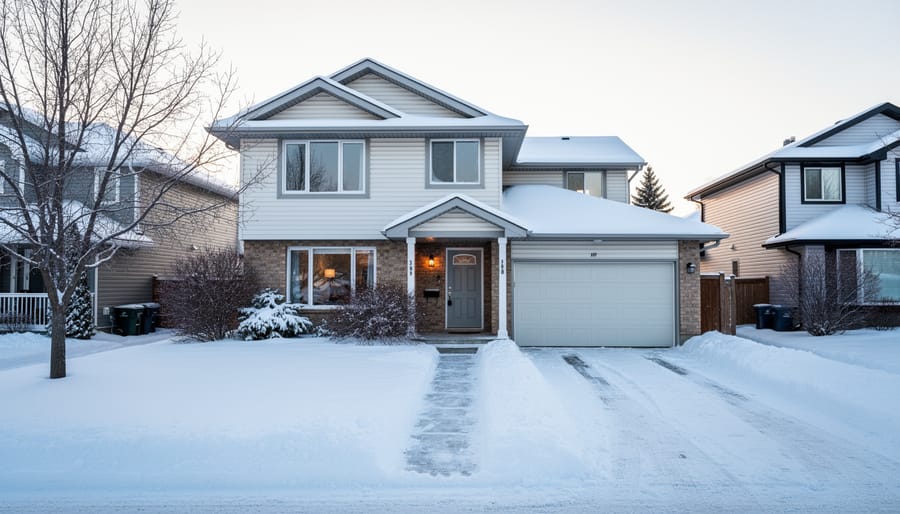
Edmonton homeowners saw a significant drop in insurance costs during 2024. According to the Edmonton 2024 insurance average residents paid $1,712 on average for the year, a 21.6% decrease compared with the same January-through-June period in the previous year. That puts Edmonton homeowners nearly 30% below the provincial benchmark, offering tangible savings for those protecting their properties in the city.
The Alberta average sits considerably higher at approximately $2,339 annually, or roughly $195 per month. Edmonton’s lower-than-average premiums reflect a combination of factors including claims history, weather patterns, and local risk profiles that insurers assess when calculating rates. Here’s how Edmonton stacks up:
| Market | Annual Cost | Monthly Cost |
|---|---|---|
| Edmonton Average (2024) | $1,712 | $143 |
| Alberta Average | $2,339 | $195 |
| Typical Alberta Range | $1,800, $3,000 | $150, $250 |
Keep in mind that the typical range across Alberta spans from $1,800 to $3,000 per year. Your actual premium will depend on your specific property and insurance profile, from the age and condition of your home to your claims history and chosen coverage level. Weather exposure plays a role too, severe weather events can push premiums higher in certain areas or for homes with particular vulnerabilities.
These figures provide a baseline for what you might expect when gathering quotes, but individual circumstances vary. Understanding where you fall within this range helps you evaluate whether the quotes you receive reflect competitive pricing for your situation.
Understanding Your Home Insurance Premium Breakdown
Your home insurance premium isn’t a single fixed charge. It bundles several distinct coverage components, each designed to protect a different aspect of your property and financial risk. Breaking down where your money goes helps you understand what you’re actually paying for and where you might adjust coverage to manage costs.
Property Coverage: The Foundation of Your Premium
The largest portion of your premium covers physical damage to your home and its contents. This includes the structure itself, walls, roof, foundation, built-in fixtures, and your personal belongings inside. Property coverage pays to repair or rebuild after covered events like fire, windstorms, hail (a significant concern in Edmonton), or theft. The cost of this component depends directly on your home’s replacement value, which reflects current construction and labor costs rather than your home’s market value.
Liability Protection: Covering Legal and Medical Costs
Liability coverage protects you if someone is injured on your property or if you accidentally damage someone else’s property. It covers legal defense costs, medical expenses, and settlements or judgments up to your policy limit. While you hope to never use it, liability protection shields your personal assets from lawsuits. Most policies in Alberta include $1 million or $2 million in liability coverage as standard.
Additional Living Expenses: Coverage When You Can’t Stay Home
If your home becomes uninhabitable due to a covered loss, say, fire damage requires extensive repairs, this coverage pays for temporary accommodation, meals, and other increased living costs while you’re displaced. It’s a smaller premium component but provides crucial support during what would otherwise be a financially stressful period.
- Dwelling coverage for the physical structure and built-in fixtures
- Contents coverage for personal belongings and furniture
- Liability protection for injuries or property damage you’re responsible for
- Additional living expenses if you need temporary housing during repairs
- Optional endorsements for specific risks like sewer backup or overland flooding
Optional Coverages: Customizing Your Protection
Standard policies exclude certain perils common in Edmonton, particularly water damage from sewer backup and overland flooding. Adding these endorsements increases your premium but closes significant coverage gaps. Other optional add-ons include increased limits for high-value items like jewelry, home business equipment coverage for entrepreneurs working from home, or earthquake coverage. Each optional coverage adds cost, so weigh the actual risk against the premium increase when deciding what to include.
What Affects Your Home Insurance Rate in Edmonton
Location and Severe Weather Exposure
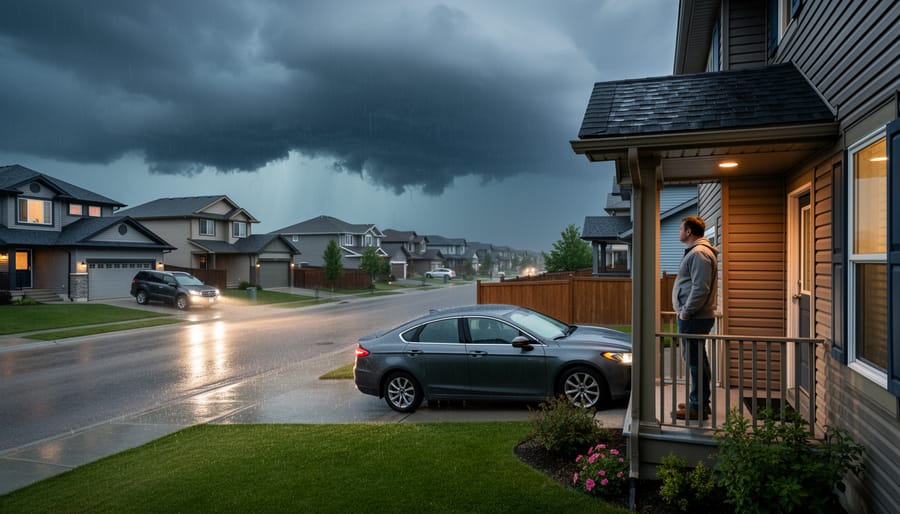
Edmonton’s geographic location puts you squarely in Alberta’s hail belt, one of the most active in North America. Insurers track historical hail damage patterns by postal code, and properties in high-frequency zones face steeper premiums because hail claims for roof and siding damage run into thousands of dollars. Your home’s proximity to the North Saskatchewan River and its tributaries also matters, even properties outside official floodplains can see rate adjustments if they’re in areas with drainage concerns or past water intrusion claims.
Fire service access plays a role too. Homes within city limits typically cost less to insure than rural properties farther from fire halls, where response times stretch longer and water supply becomes uncertain. Insurers measure this using a fire protection rating tied to your address.
Severe weather exposure drives much of Edmonton’s premium variability. A home in a moderate hail zone with good fire protection will pay noticeably less than an identical house in a high-risk area. When you request quotes, expect insurers to ask detailed location questions, they’re not being nosy, they’re calculating your specific weather and emergency response risk profile.
Age and Condition of Your Home

Older homes generally cost more to insure because they present higher risk to insurers. A house built before 1980 often contains outdated electrical systems, aging plumbing, and materials that no longer meet current building codes, all of which increase the likelihood of claims from fire, water damage, or structural failure.
When assessing your home’s condition, insurers look at several key elements. They want to know the age and type of your roof, since older shingles are more prone to hail and wind damage. The electrical panel matters too: knob-and-tube wiring or aluminum wiring can make coverage harder to obtain or more expensive. They’ll ask about your heating system, plumbing materials (especially poly-B or galvanized pipes), and whether you’ve completed major upgrades like a furnace replacement or window renewal.
If you own an older property in Edmonton, consider updating high-risk components before shopping for quotes. Even modest improvements, like replacing an aging roof or upgrading electrical service, can lower your premium and make you eligible for broader coverage options.
Replacement Cost and Rebuilding Expenses
Your home’s replacement cost, what it would cost to rebuild from the ground up, matters far more to your insurer than its market value. A house selling for $400,000 might require $550,000 to rebuild if construction materials and labor run high. That gap explains why insurance premiums don’t mirror real estate prices.
Edmonton’s construction costs directly influence your premium. When the price of lumber, roofing materials, or skilled trades rises, replacement costs climb, and insurers adjust rates accordingly. A 2,200-square-foot home costs more to insure than a 1,500-square-foot home because there’s simply more to rebuild if disaster strikes.
Insurers calculate replacement cost by evaluating your home’s square footage, construction quality, finishes, and any custom features like hardwood floors or granite counters. They factor in current local labor rates and material costs, then apply those figures to your specific property. Older homes with unique architectural details or hard-to-source materials typically carry higher replacement costs, and higher premiums, than standard new builds.
Understanding this distinction helps you avoid underinsuring. Coverage based on market value might leave you with a significant shortfall after a total loss.
Your Claims History
Your claims history carries significant weight when insurers calculate your premium. Every claim you file, whether it’s property damage, liability, or theft, gets recorded in a shared industry database that Alberta insurers check when you apply for coverage. Even one claim in the past three to five years can increase your rate by 10% to 25%, and multiple claims may make it difficult to find affordable coverage at all.
Both property-specific claims (like previous flood damage at your address) and your personal claims history (following you from property to property) factor into the equation. Insurers view frequent claims as a predictor of future risk, regardless of fault. Most claims remain on your record for three to seven years depending on the insurer and claim severity, though catastrophic claims like fire may appear longer.
This creates a practical dilemma: filing a claim for minor damage that barely exceeds your deductible often costs more in premium increases over subsequent years than paying out of pocket. Before filing, calculate whether the claim payout minus your deductible justifies the likely rate impact, especially for losses under $2,500.
Coverage Type and Optional Add-Ons
Your policy type forms the foundation of your premium, with the price difference between basic and comprehensive coverage often running $300, $800 annually in Edmonton. Basic coverage typically protects against named perils like fire, lightning, and windstorm, while comprehensive (all-risk) policies cover everything except what’s specifically excluded, offering broader protection at a higher cost.
Optional add-ons can push your premium higher, but many Edmonton homeowners find them worthwhile given local risks. Water damage protection, including sewer backup coverage, commonly adds $100, $300 to your annual premium but addresses a significant claim source in the region. Overland flood insurance, which became more widely available in recent years, can increase costs by $200, $500 depending on your property’s flood risk designation.
Other common optional coverages that affect your bottom line include equipment breakdown protection, identity theft coverage, and increased liability limits beyond the standard $1 million. Earthquake coverage remains relatively inexpensive in Alberta but adds a modest premium increase. Service line coverage for underground pipes and wiring typically costs $50, $150 annually.
When evaluating add-ons, consider your property’s specific vulnerabilities and your financial capacity to handle certain losses out-of-pocket. Comprehensive coverage with targeted optional protections often provides better value than basic coverage that leaves critical gaps, especially for small business owners who may store equipment or inventory at home.
Managing Your Own Insurance Shopping vs. Working with a Broker

When you’re ready to get Edmonton home insurance quotes, you face a straightforward choice: gather quotes yourself directly from insurers or work with a broker who shops on your behalf. Each approach has distinct trade-offs that matter especially to small business owners managing multiple priorities.
The DIY route means visiting individual insurer websites or using online comparison tools to request quotes. You control the process completely and interact directly with each company. This works well if you have a straightforward property, standard construction, no claims history, basic coverage needs, and the time to input your information multiple times. You’ll typically get quotes from larger insurers with strong online platforms, though you may miss smaller or specialty carriers that don’t offer direct online quotes.
Working with a broker shifts the legwork to a professional who knows the Edmonton market. You provide your details once, and the broker shops multiple insurers simultaneously, including markets you can’t easily access on your own. A good broker explains coverage differences, spots gaps in protection, and handles renewals and claims advocacy. For entrepreneurs juggling business operations, this saves hours and leverages expertise you’d otherwise need to build yourself.
Pros of Using a Broker
- Access to multiple insurers and specialty markets from a single conversation.
- Expert guidance on coverage adequacy and Edmonton-specific risks like hail or sewer backup.
- Ongoing service for claims support, policy adjustments, and renewal shopping.
- Time savings, you provide information once instead of repeating it across multiple sites.
Cons of Using a Broker
- You rely on the broker’s knowledge and diligence rather than controlling the search yourself.
- Not all brokers represent every insurer, so coverage options depend on their partnerships.
- Initial meetings or calls take coordination, though many brokers now work efficiently by phone or email.
Cost is rarely a deciding factor, brokers earn commissions from insurers, not fees from you, so you don’t pay extra for their service. The real question is whether you value the time saved and market access enough to delegate the shopping process. Given that Edmonton homeowners paid an average of $1,712 in 2024, even a modest difference found through broader market access can justify the broker route, especially when your time has competing demands from running a business.
Practical Ways to Lower Your Home Insurance Costs
Reducing your home insurance premium doesn’t require sacrificing the protection your property needs. Edmonton homeowners can implement several straightforward strategies that insurers reward with lower rates.
Bundling your home and auto insurance with the same provider typically delivers the most immediate discount, often 10% to 15% on both policies. Most insurers offer this multi-policy reduction because it lowers their administrative costs and increases customer retention. If you own a small business vehicle or multiple cars, the savings compound further.
Raising your deductible from $500 to $1,000 or $2,500 directly lowers your annual premium. You’re assuming more risk upfront in exchange for reduced monthly costs. This makes financial sense if you maintain an emergency fund and plan to file claims only for significant losses rather than minor repairs.
Insurers also reduce premiums for homes with documented risk-reduction measures:
- Installing a monitored security system can cut premiums by 5% to 15%
- Upgrading outdated electrical wiring, plumbing, or heating systems reduces claim risk
- Adding storm shutters or impact-resistant roofing materials in hail-prone areas
- Modernizing your home with a newer roof (less than 15 years old) typically qualifies for better rates
- Maintaining a claims-free record for three to five years often unlocks loyalty discounts
Regular maintenance matters too. Insurers view well-maintained homes as lower risk. Keep records of roof inspections, furnace servicing, and major updates, some providers request this documentation for their best rates.
Review your coverage annually. As you pay down your mortgage or as your home’s contents change, you might be overinsured. Edmonton’s average premium of $1,712 reflects varied coverage levels, so ensure you’re paying only for protection you actually need. Many homeowners drop unnecessary endorsements after reviewing what’s already included in their base policy.
Where the Money Goes
Your $1,712 annual Edmonton home insurance premium isn’t a single fixed cost. Insurers break it down across several distinct components, each protecting you from different risks.
Property coverage takes the largest share, typically 50-60% of your total premium. This portion directly correlates with your home’s replacement cost, what it would take to rebuild your house from the ground up using current Edmonton construction prices. Insurers calculate this using local labour rates, material costs, and building codes.
Liability protection accounts for roughly 15-20% of your premium. This covers you if someone is injured on your property or if you accidentally damage someone else’s property. Most policies start at $1 million coverage, with higher limits available.
Additional living expenses coverage represents about 10-15% of your bill. If your home becomes uninhabitable due to an insured event, this pays for temporary accommodation, meals, and other living costs while repairs happen.
Optional coverages and endorsements make up the remaining 10-20%. Water damage protection, sewer backup coverage, equipment breakdown insurance, and increased limits for valuables all add incremental costs. These optional add-ons can significantly impact your total premium depending on which protections you choose for your specific situation and property risks.
DIY vs Hiring a Pro
Getting your own Edmonton home insurance quotes online takes an hour or two to complete applications across multiple insurer websites. You’ll enter your property details, coverage preferences, and personal information several times, then compare the results yourself. This approach costs nothing upfront and gives you direct control, but you’re limited to companies with online quoting systems and you shoulder the responsibility of understanding policy differences and coverage gaps.
Working with an insurance broker saves you the repetitive data entry and taps into their market knowledge of Edmonton-specific factors like severe weather exposure and local claim patterns. Brokers access multiple insurers through one conversation and can explain which coverage actually protects your situation versus what just inflates the premium. For small business owners juggling home office expensesproperty maintenance and business liability questions, a broker’s expertise often reveals bundling opportunities or coverage adjustments you wouldn’t find alone. The trade-off is less immediate control and potentially waiting for callback times.
The right choice depends on your comfort with insurance language and your time availability. If you’re already working with a financial consultant on business matters or applying tax planning tips to manage expenses, adding a broker conversation often fits that same efficient, expert-guided approach to protecting your assets.
Steps at a Glance
Getting competitive home insurance quotes in Edmonton doesn’t have to be complicated. Follow this straightforward process to find the coverage you need at a rate that fits your budget:
- Gather key property details, construction year, square footage, roof age, heating system type, and recent upgrades. Insurers need this information to calculate accurate quotes.
- Document your coverage needs, including replacement cost estimate, desired liability limits, and any valuable items requiring additional protection. First-time home buyers should pay special attention to mandatory lender requirements.
- Request quotes from at least three insurers or use a broker who can compare multiple carriers simultaneously. Provide identical coverage specifications to each for accurate comparison.
- Review each quote’s coverage details, not just the premium amount. Check deductibles, exclusions, and whether water damage and sewer backup protection are included.
- Ask about available discounts, bundling policies, claims-free history, security systems, and mortgage-free status can all reduce your premium.
- Verify the insurer’s reputation and claims service record before committing. A lower premium means little if claims handling is poor.
Most Edmonton homeowners complete this process within a few days. Working with a broker can compress the timeline since they handle multiple carrier contacts on your behalf, saving you the back-and-forth of individual applications.
Common Questions About Edmonton Home Insurance Quotes
What information do I need to get accurate home insurance quotes in Edmonton?
You’ll need your home’s address, year built, square footage, construction type, heating and electrical system details, any recent renovations, and current mortgage information. Insurers also ask about claims history, home security features, and the replacement cost estimate for your property.
How do I effectively compare home insurance quotes from different providers?
Compare identical coverage limits and deductibles across all quotes, not just the premium price. Check what each policy includes for water damage, sewer backup, and additional living expenses, as these vary widely between insurers and significantly affect real-world protection.
When is the best time to shop for new home insurance coverage?
Start gathering quotes 30 to 45 days before your current policy renews. This gives you enough time to compare options without rushing, and you can switch seamlessly at renewal without coverage gaps or cancellation fees.
Does running a business from my Edmonton home affect my insurance quotes?
Yes. Standard home insurance typically excludes business property and liability, so you’ll need to declare your home-based business to your insurer. Many providers offer affordable home business endorsements, while larger operations may require separate commercial policies, disclosure prevents claim denials later.
Most Edmonton homeowners find that preparing a simple list of their home’s specifications before requesting quotes saves considerable back-and-forth with insurers. Take photos of recent upgrades like your roof, furnace, or electrical panel, these can help secure better rates if they demonstrate your home is well-maintained.
If you’re an entrepreneur working from home, clarify exactly what business activities happen on your property and what equipment or inventory you keep there. A freelance consultant working on a laptop needs different coverage than someone storing product inventory or meeting clients on-site. Being specific helps insurers quote accurately and ensures you’re not paying for coverage you don’t need or missing protection you do.
Edmonton homeowners enjoy a notable advantage, with average premiums sitting 29.3% below the Alberta average at $1,712 annually. That’s a meaningful saving compared to the typical provincial range of $1,800 to $3,000, and it reflects the city’s lower risk profile relative to other regions. But this below-average baseline doesn’t eliminate the need to compare quotes or understand what drives your specific rate.
Your property’s age, location within Edmonton, claims history, and coverage choices all create variability that can push your premium well above or below that $1,712 average. Taking time to gather multiple quotes with a clear sense of your needs, replacement cost, liability limits, optional coverages, helps you find competitive rates without leaving coverage gaps. For small business owners protecting both personal and business assets under one roof, this clarity becomes even more important.
Insurance costs matter, especially when you’re managing tight margins and multiple financial priorities. Approach your home insurance decision with the same cost-conscious, informed mindset you bring to your business. Compare options, ask questions, and choose coverage that protects what matters without overpaying for what doesn’t.